 |
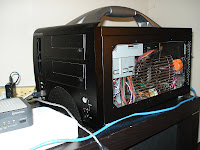
Inside of... the new hotness... |
new toy...
I had a recent discovery... VMWARE CRUMBLES under situations where the shutdown is less than planned, I could reboot and fsck vista, however vmware would not sync up due to untold and countless numbers of sync, lock, and snapshot inconsistencies. after a dozen rescues and one nasty failure, this got old. It was time to move gentoo onto my former AMD dual core and reuse some DDR2 sticks which were mismatched with other sets of 4.now it's running (and building) ResearchCyc 1.0 and performing filesystem experiments for the Billion Triples Challenge.
Not bad for a silent living room box with a console on my hd-tv
| Silent But gladly | Setback | More…. |
| case | $120.00 | Thermaltake Lanbox |
| Motherboard | $80.00 | MSI K9AGM2-FIH Socket AM2 AMD 690G DDR2 mATX Motherboard w/ HDMI, FireWire, Radeon 1250 Video, 8ch Audio, and GigaBit LAN. |
| PSU | $130.00 | Zalman ZM-600 HP Heatpipe Cooled PSU. blue internal light. |
| CPU cooler | $80.00 | ZALMAN CNPS 9500 AM2 2 Ball CPU Cooling Fan/Heatsink-- squashed about 1.5 inches. fan bent 50 degrees aimed at chipset riser. flush to PSU intake fan above at about 1-2 cm apart. |
| System Media | $50.00 | (4gb) scsi 0:0:0:0: Direct-Access LEXAR JD LIGHTNING II 1100 PQ: 0 ANSI: 0 CCS. |
| CPU | $240.00 | AMD Athlon(tm) 64 X2 Dual Core Processor 3800+ stepping 02 - 2.0 ghz |
| RAM | $130.00 | Patriot Viper 4GB (2 x 2GB) 240-Pin DDR2 SDRAM DDR2 1066 (PC2 8500) Dual Channel Kit Desktop Memory @ 800mhz |
| keyboard | $20.00 | 1998 M$ Internet Explorer Keyboard, usb+ps2+hub used for xbox, this machine, approx 30-40 machines before it, 100's of OS installs across 4 generations of CPU-- 300 bogomips up to 22000 OC q6600. |
| noise levels | $0.00 | PSU noise only, silent to within 1 foot of case. our flourescent bulbs make more noise than the box. qfan on max cooling 40 degree 5 degree |
| case fans | $0.00 | 3, fixed-voltage, disconnected for noise and wear. 2 on back deck above accessories panel. 1 blue lighted fan in front. The case fans were stock however the connectors are 2-pin and the fans make a lot more noise than the PSU. |
| video | $0.00 | hdmi over radeon 500/AMD/Ati 1250. |
| System Media | $0.00 | (4gb) scsi 0:0:0:0: Direct-Access LEXAR JD LIGHTNING II 1100 PQ: 0 ANSI: 0 CCS. |
| Ethernet | $0.00 | cat 5e tested good to 75% gig-e utilization |
| Cha-Ching!!! | $850.00 | |
This was a mounted cifs volume to my quad-core vista with raid-0 across 3 drives (~170 M/s during the rare opportunity for non-interrupted linear IO under vista)
livecd slow # mount |grep slow //10.0.12.223/in on /mnt/slow type cifs (rw,user=guest)a write test, and speed-indicator prior to loop-mounting over cifs.
livecd slow # dd if=/dev/zero of=ntfs.test count=16 bs=256M 16+0 records in 16+0 records out
256+0 records in
256+0 records out
4294967296 bytes (4.3 GB) copied, 52.1532 s, 82.4 MB/sthe LEXAR media benchmark, livecd slow # hdparm --direct -t /dev/sda
/dev/sda: Timing O_DIRECT disk reads: 100 MB in 3.05 seconds = 32.79 MB/sec
the general size of the running image with portage rsync'd, and kernel sources installed and built without clean.
livecd slow # du / -xs
3926493 /livecd slow # df -h
Filesystem Size Used Avail Use% Mounted /dev/sda1 3.8G 3.5G 262M 94.00% / /tmp 1.9G 28K 1.9G 1.00% /tmp /vol/image.squashfs 1.6G 1.6G 0B 100.00% /mnt/livecd udev 10M 112K 9.9M 2.00% /dev vartmp 1.9G 554M 1.4G 29.00% /var/tmp
Other Features:
this working gentoo installation is a live-cd from thumb-drive -- the livecd squashfs image provides 1.6 gigs of AMD64 gentoo, which is about 4 gigs uncompressed even with reiserfs tails.
Rather than run in a read-only FS the command:
cp -asx /mnt/livecd/{usr,opt,lib,dev} /mnt/gento
...provides the read-only but replaceable base filesystem (all directories full of symlinks pointing back to the read-only compressed volume), leaving the other dirs to exists as-first class persistent files. without /etc, /bin, /sbin, /lib, and /var using genuine files, the system doesn't bootstrap well.
portage plays nicely with this configuration. using the livecd (on USB dvd) seems to provide the grub package without forcing the emerge (of grub) step in stage 3. big time saver.
portage plays nicely with this configuration. using the livecd (on USB dvd) seems to provide the grub package without forcing the emerge (of grub) step in stage 3. big time saver.
Yet TODO:
my original hunch was to build a thumbdrive linux, and then transfer the filesystem to a flat image file with an nfs server boot and tftpd with pxegrub.
benchmarking the network filesystem confirms this (gig-e link) as a valid route to performance. The vista (x64) server has 8 gigs which will help out with access turnaround, but building the userspace nfsd on vista might be a chore. cygwin nfsd will chew up an entire core on high speed transfers, that's not likely to help much.
update: vista has been retired. a new mac book pro has taken its place. The quadcore and terabytes await razing some time soon with a gentoo clone of the living room machine (at 82M/s !!).


